"These observations are transforming our understanding of galaxy evolution," said Richard S. Ellis, Professor of Astrophysics at University College London (UCL) and a co-author of one of two new studies published in Nature. "It had been assumed that the earliest galaxies would have been chaotic and irregular, and it's a great surprise to find that they have ordered, rotating structures much like modern spiral galaxies, only a few hundred million years after the Big Bang."
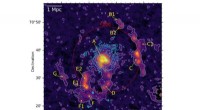
The early universe was a chaotic place, filled with gas, dust, and the remnants of the Big Bang. Astronomers had expected to find that the first galaxies to form would be small and irregular, with little structure. However, the new ALMA observations show that some of these early galaxies were actually quite large and well-organized, with spiral arms and bars similar to those seen in galaxies today.
The observations also suggest that these early galaxies were forming stars at a much faster rate than galaxies today. This is evident in the bright, glowing centers of the galaxies, which are regions of intense star formation.
The new findings challenge our current understanding of galaxy evolution and suggest that the early universe may have been a more complex and diverse place than previously thought.
"We're looking at a time in the history of the universe when we believe the galaxies were only about one billion years old," said Takuma Izumi, a researcher at the National Astronomical Observatory of Japan and lead author of one of the studies. "That's like looking at a baby picture of the current universe, and it's amazing to see how developed and structured these early galaxies appear to be."
The ALMA observations are part of a larger project called the Atacama Large (Sub)millimeter Aperture Survey (ATLAS), which is using ALMA to image the distant universe in unprecedented detail. The new images from ATLAS are providing astronomers with a wealth of new information about the early universe, and they are challenging our current understanding of how galaxies form and evolve.
"These new observations are really changing the way we think about the early universe," said Chris Carilli, Director of the National Radio Astronomy Observatory (NRAO) in Socorro, New Mexico, USA, and a co-author of one of the studies. "It's clear that the early universe was a much more complex and dynamic place than we had ever imagined."