The observations revealed an Earth-like rotation rate for at least one brown dwarf and provide important clues to how clouds and precipitation condense in cooler atmospheres, such as those of planets orbiting other stars.
"We are seeing strong similarities and a lot of common behaviors between brown dwarfs and planets," said Michael Cushing of the University of Toledo in Ohio, lead author of a paper describing the findings in the Astrophysical Journal.
Brown dwarfs are oddballs that do not quite make the cut to be considered full-fledged stars, which fuse hydrogen atoms in their cores. Although much larger than planets—and they form more like stars than planets—brown dwarfs aren't quite large enough to engage in nuclear fusion and end up as burnt-out cinders.
About the size of Jupiter but between 50 and 75 times as massive, brown dwarfs have temperatures and surface gravities in between those of stars and planets. Their intermediate temperatures and properties give these star wannabes a special role as "benchmark" objects for bridging the gap in understanding how stars form on one end and planets form on the other.
By studying objects that fit this bill—so-called ultracool dwarfs—the Spitzer team discovered cloud patterns and dynamics analogous to those seen on Earth. The scientists made these discoveries by studying weather patterns on several ultracool dwarfs, all located within 20 to 50 light-years from Earth.
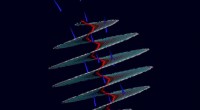
A key characteristic, similar to that of Jupiter, is that the brown dwarfs displayed large, bright cloud features that persisted for multiple viewing periods, suggesting that their fast rotational speeds are distributing the clouds uniformly across their surfaces. The large cloud features suggest that the atmospheres are extremely dynamic, like Earth's, and that the heat redistribution mechanisms are similar to processes that transport energy in the Earth's atmosphere.
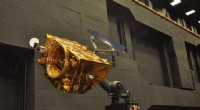
Observations were taken of six brown dwarfs with an infrared camera aboard Spitzer. Infrared light allowed the team to peer through the obscuring layers of dust surrounding these objects, helping to reveal their atmospheres and cloud cover.
"We can clearly see that the atmospheres are very dynamic and evolve on hour to day timescales, just like weather," Cushing said.
The Spitzer team also found evidence of patchy clouds and precipitation, which might be responsible for creating dark streaks, or gaps, in the cloud cover. These features appear similar to convective cloud systems seen in the atmospheres of planets throughout our solar system.