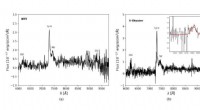
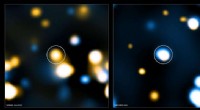
The observations provide insight into the origin of Type Ia supernovae, shedding light on the long-standing question of how these explosions are triggered. The team found that the UV flash, which lasted only about 10 seconds, may be the long-sought-after "ignition signal" that sets off the thermonuclear explosion.
The research, published today in the journal Nature, was led by Peter Garnavich, a research scientist in MIT's Department of Physics. Co-authors include Alicia Soderberg and Dheeraj Pasham from MIT, as well as researchers from Las Cumbres Observatory Global Telescope Network, University of California, Berkeley, and Northwestern University.
Type Ia supernovae are important for a number of reasons. First, they are used as standard candles to measure distances to galaxies, and thus play a key role in cosmology. Second, they are thought to be the main source of iron and other heavy elements in the universe, which are essential for life.
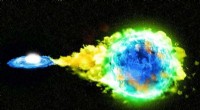
However, the exact details of how Type Ia supernovae are triggered have remained a mystery. One leading theory is that the explosion is caused by a thermonuclear runaway in a carbon-oxygen white dwarf. In this scenario, the white dwarf accretes matter from a companion star, until it reaches a critical mass, leading to a thermonuclear explosion.
The new observations support this scenario. The team detected the UV flash just before the supernova explosion, suggesting that the flash may be the ignition signal that triggers the thermonuclear runaway. The flash is thought to be produced by the collision of two subsonic detonation fronts in the white dwarf's core.
"This is the first time we have seen such a clear and direct connection between a UV flash and a Type Ia supernova," Garnavich says. "This suggests that the UV flash is the long-sought-after smoking gun that triggers these explosions."
The team used data from the Large Synoptic Survey Telescope (LSST) and the Zwicky Transient Facility to observe the UV flash. The LSST is a wide-field survey telescope, and the Zwicky Transient Facility is a rapid-response telescope designed to follow up on transient events.
The researchers say that the new observations provide important clues about the physics of Type Ia supernovae, and will help to improve models of these explosions. This will lead to better measurements of distances to galaxies and a better understanding of the origin of the heavy elements in the universe.
"These observations are a major breakthrough in our understanding of Type Ia supernovae," Soderberg says. "We are finally starting to piece together the puzzle of how these explosions work."