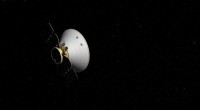
Here's a step-by-step explanation of how the Hope probe journeyed to Mars and achieved its Martian orbit insertion:
1. Launch:
- The Hope probe was launched on July 20, 2020, from the Tanegashima Space Center in Japan aboard a Mitsubishi Heavy Industries H-IIA launch vehicle.
- The probe's journey to Mars covered a distance of approximately 494 million kilometers (307 million miles).
2. Cruise Phase:
- After launch, the probe entered a cruise phase where it traveled towards Mars for about seven months.
- During this phase, the probe's trajectory was monitored and adjusted as needed to ensure an accurate approach to Mars.
3. Mars Orbit Insertion (MOI):
- As the probe neared Mars, it initiated the critical Mars Orbit Insertion maneuver on February 9, 2021.
- This maneuver involved firing the probe's main engine for about 27 minutes to slow down and enter Mars' gravitational field.
- The successful MOI placed the probe into an elliptical orbit around Mars, with the closest point (periapsis) at approximately 1,000 kilometers (621 miles) and the farthest point (apoapsis) at about 43,000 kilometers (26,700 miles) above the planet's surface.
4. Orbit Maintenance and Science Phase:
- After achieving MOI, the Hope probe spent several weeks adjusting its orbit and conducting various tests to ensure its systems were functioning properly.
- The probe eventually settled into a science orbit with a periapsis of about 20,000 kilometers (12,400 miles) and an apoapsis of 43,000 kilometers (26,700 miles).
- From this orbit, the Hope probe began its primary scientific mission to study Mars' atmosphere and weather conditions, including its climate and seasonal changes.
5. Communication with Earth:
- Communication between the Hope probe and Earth is critical for transmitting scientific data and monitoring the probe's status.
- The probe communicates with Earth via the Deep Space Network (DSN), a global network of radio telescopes operated by NASA and other international space agencies.
- The DSN provides communication support for various spacecraft exploring the solar system, including the Hope probe.
The successful Mars Orbit Insertion of the Hope probe marked a significant milestone for the UAE's space program and underscores its growing capabilities in space exploration.