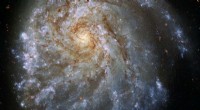
The new technique was developed by a team of astronomers led by Dr. Eric Bell of the University of Michigan. Bell and his team used the Hubble Space Telescope to observe a sample of nearby galaxies. They then used computer models to calculate the mass-to-light ratio of each galaxy.
The mass-to-light ratio is a measure of how much mass is contained in a galaxy compared to how much light it emits. A high mass-to-light ratio means that a galaxy contains a lot of dark matter, which is invisible to telescopes. Dark matter is thought to make up about 27% of the universe, but its nature is still unknown.
The astronomers found that the mass-to-light ratio of galaxies varies from the center to the outskirts. The central cores of galaxies have a high mass-to-light ratio, while the outskirts have a low mass-to-light ratio. This suggests that the central cores of galaxies are made up of a lot of dark matter, while the outskirts are made up of more visible matter, such as stars and gas.
The new technique provides astronomers with a new way to study the growth of galaxies. By measuring the mass-to-light ratio of galaxies, astronomers can learn more about the distribution of dark matter in galaxies. This information can help them to understand how galaxies form and evolve over time.
The new technique is a powerful tool that will help astronomers to learn more about the universe. It is a significant advance in our understanding of how galaxies grow.