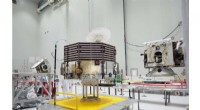
The European Space Agency's (ESA) CHEOPS satellite is a small space telescope that will be launched in late 2022. CHEOPS will be used to study exoplanets, or planets that orbit stars other than the Sun.
CHEOPS will improve the hunt for exoplanets by observing stars that are already known to have planets. By measuring the brightness of these stars as the planets pass in front of them, CHEOPS will be able to determine the size and shape of the planets. CHEOPS will also be able to measure the planets' atmospheres, which will help scientists learn more about their composition and climate.
CHEOPS is a very important mission because it will help scientists learn more about the planets that exist in our galaxy. By studying exoplanets, scientists can better understand the formation and evolution of planetary systems and how planets become habitable.
Key Features of the CHEOPS Satellite
* Mass: 113 kg (249 lbs)
* Size: 1.5 x 1.5 x 1.5 m (4.9 x 4.9 x 4.9 ft)
* Power: 1.2 kW
* Orbit: Sun-synchronous orbit, 700 km (435 mi) above Earth
* Telescope: 32-cm (12.6-in) diameter
* Camera: 1-megapixel CMOS detector
* Sensitivity: Visible light (450-900 nm)
How CHEOPS Will Work
CHEOPS will observe stars that are already known to have planets. These planets will have been discovered by other telescopes, such as the Kepler space telescope. CHEOPS will then measure the brightness of these stars as the planets pass in front of them. This will allow CHEOPS to determine the size and shape of the planets.
CHEOPS will also be able to measure the planets' atmospheres by looking at how they absorb light from the stars. This will help scientists learn more about the composition and climate of the planets.
CHEOPS Science Objectives
The primary science objectives of the CHEOPS mission are to:
* Determine the size, shape, and mass of exoplanets
* Measure the atmospheres of exoplanets
* Search for new exoplanets
CHEOPS Mission Timeline
The CHEOPS mission is scheduled to launch in late 2022. The satellite will then be commissioned for six months before beginning its science operations. The science operations phase is expected to last for three and a half years.
CHEOPS Cost
The total cost of the CHEOPS mission is estimated to be €150 million (US$170 million).
CHEOPS Partners
The CHEOPS mission is a collaboration between ESA and Switzerland. The University of Bern is the lead institution for the mission. Other partners include the University of Geneva, the University of Zurich, and the Swiss National Science Foundation.
CHEOPS Impact
The CHEOPS mission is expected to have a significant impact on the field of exoplanet research. The mission will provide new information about the size, shape, and composition of exoplanets, and it may even help to discover new exoplanets. The CHEOPS mission will also help scientists to better understand the formation and evolution of planetary systems.