Using data from the European Space Agency's Gaia satellite, researchers from the University of Zurich in Switzerland have found that dark matter particles must be either very light, with a mass less than one billionth of that of a proton, or very heavy, with a mass more than 100 quadrillion times that of a proton.
This is a significant breakthrough, as previous estimates of dark matter's mass have ranged from as light as a single atom to as heavy as a small planet.
"Our findings rule out a large part of the previously allowed mass range for dark matter particles," said Dr. Ana Bonaca, lead author of the study, which was published in the journal Physical Review Letters.
"This is an important step forward in our understanding of this mysterious substance."
Dark matter is thought to make up around 27% of the universe, but it has never been directly detected. Scientists believe that it is a type of matter that does not interact with any of the forces that we know about, except for gravity.
This means that it is invisible to our telescopes and very difficult to study.
However, scientists can infer the existence of dark matter by its gravitational effects on visible matter. For example, dark matter is thought to be responsible for the rotation curves of galaxies, which show that galaxies rotate faster than they should if they were only made of visible matter.
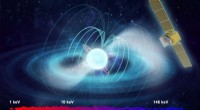
The Gaia satellite is a spacecraft that was launched in 2013 to measure the positions, distances, and motions of stars in our galaxy. The data from Gaia has allowed scientists to map the distribution of dark matter in the Milky Way with unprecedented accuracy.
This map has allowed the University of Zurich researchers to calculate the mass range of dark matter particles for the first time.
"Our findings are based on the assumption that dark matter is made up of a single type of particle," said Dr. Bonaca.
"If dark matter is actually made up of multiple types of particles, then the mass range could be different."
The researchers hope that their findings will help to narrow down the search for dark matter and eventually lead to its direct detection.