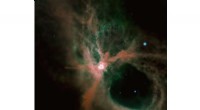
1. Ejection from a planetary system: Rogue planets may be ejected from their original planetary systems due to gravitational interactions with other planets or close encounters with massive objects like passing stars. In such scenarios, the planet's orbit becomes highly eccentric or hyperbolic, causing it to escape the system's gravitational pull and become unbound.
2. Failed star formation: Some rogue planets may have formed through the same processes that lead to star formation but failed to accumulate enough mass to ignite nuclear fusion. These objects, often called "brown dwarfs," may have characteristics similar to planets but lack the mass and internal pressure required to sustain stable fusion reactions.
3. Primordial formation: Rogue planets may also form in the early stages of star and planetary system formation, before the collapse of a molecular cloud into a protostar. During this phase, small clumps of matter can coalesce into planet-like objects that remain unbound to any specific star.
4. Galactic tidal forces: In the dense environments of galactic centers or crowded star clusters, the gravitational forces exerted by numerous stars can disrupt planetary systems. This can lead to the ejection of planets from their original orbits and their transformation into rogue planets.
5. Stellar evolution: As stars evolve and undergo various stages, such as supernova explosions or the expansion into red giants, their planetary systems can be disrupted. Some planets may be ejected into interstellar space as a result of these dramatic changes.
6. Planetary collisions: In densely populated planetary systems, collisions between planets can occur. These collisions can impart enough energy to eject one or both planets from the system, sending them into a rogue trajectory.
Once rogue planets are in interstellar space, they continue to wander freely, influenced by the gravitational forces of nearby stars and the overall dynamics of the galaxy. They may eventually be captured by another star or planetary system, or they may remain solitary nomads for billions of years.
The study of rogue planets is still in its early stages, and many mysteries remain about their origins, compositions, and interactions with other celestial objects. As astronomers continue to explore the vast expanse of space, they hope to uncover more insights into these enigmatic wanderers of the galaxy.