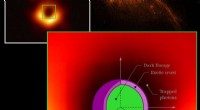
1. Neutron Star and Black Hole Interiors: Gravitational waves emitted by the collision or merger of neutron stars and black holes carry information about the dense matter present in these objects. By analyzing the gravitational waveforms, scientists can infer properties like the equation of state of neutron star matter, which describes the relationship between pressure and density inside neutron stars. This helps us understand the behavior of matter under extreme pressure and can shed light on exotic states of matter, such as quark-gluon plasma.
2. Compact Object Binaries: Gravitational waves from binary systems composed of compact objects, such as neutron star-neutron star or black hole-black hole binaries, can provide insights into the masses, spins, and orbital parameters of these systems. By measuring the precise arrival time and frequency evolution of the gravitational waves, scientists can extract information about the nature of the compact objects, including their masses and radii. This helps us understand the properties and evolution of these fascinating binary systems.
3. Dark Matter and Massive Black Holes: Gravitational waves can potentially probe the existence and properties of dark matter and massive black holes. Certain theories predict the formation of primordial black holes in the early universe, which could merge and produce detectable gravitational waves. Observing such gravitational waves would provide evidence for the existence of these dark matter candidates. Additionally, the detection of gravitational waves from the mergers of supermassive black holes can provide insights into the growth and evolution of these behemoths and their role in shaping the universe.
4. Modified Theories of Gravity: Gravitational waves can also be used to test alternative theories of gravity. General relativity, while highly successful, is not the only theory that describes gravity. Modified theories of gravity predict deviations from the predictions of general relativity, which could potentially be detected through the analysis of gravitational waves. By comparing the observed waveforms with those predicted by different theories, scientists can constrain or rule out certain alternatives to general relativity.
5. Probing Fundamental Physics: Gravitational waves provide a unique opportunity to probe fundamental physics beyond the standard model of particle physics. Theories like string theory and loop quantum gravity make predictions about the behavior of spacetime and the nature of gravity. By studying the properties of gravitational waves and comparing them with theoretical models, scientists can gain insights into the fundamental constituents of matter and the underlying laws that govern the universe.
Overall, gravitational waves offer a powerful tool to explore matter under extreme conditions, investigate the properties of compact objects, probe dark matter and massive black holes, test modified theories of gravity, and unravel fundamental physics. They provide a new avenue for understanding the nature of matter and the cosmos, promising groundbreaking discoveries and a deeper understanding of the universe.