1. Testing General Relativity:
Observations of black holes, especially their event horizons and the phenomena associated with them, serve as rigorous tests of the predictions of general relativity—one of the fundamental pillars of modern physics. Any deviations from the predicted behavior could point to new physics.
2. Accretion and Jet Formation:
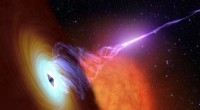
Black holes actively accrete matter from their surroundings, releasing tremendous amounts of energy. By studying the dynamics of accretion disks and the formation of powerful jets of particles, we can understand the mechanisms by which black holes release energy and influence their environments.
3. Galaxy Evolution:
Supermassive black holes are believed to play a crucial role in galaxy evolution. By studying the correlation between black hole properties and characteristics of their host galaxies, we can uncover their mutual influence and understand how galaxies have evolved over time.
4. Large-Scale Structures:
Supermassive black holes may be influential in forming large-scale structures in the universe such as galaxy clusters. By characterizing the interplay between black holes and galactic distributions, we gain insights into the hierarchical assembly of these systems.
5. Cosmic Census:
Imaging black holes helps create a census of their abundance, mass, and other properties across the universe. This cosmic census provides insights into the formation and evolution of black holes and the role they play in shaping the observable cosmos.
6. Gravitational Waves:
Observing black holes in dynamic states (accreting, merging) provides observational probes for the detection of gravitational waves—ripples in spacetime predicted by general relativity. Such observations help confirm the existence of these waves and contribute to multi-messenger astrophysics.
7. Dark Matter:
Black holes and the dynamics of stars around them offer indirect evidence for the existence of dark matter—a mysterious form of matter that influences gravitational dynamics but does not emit light.
8. Fundamental Physics:
Some theories predict deviations from general relativity in the vicinity of black holes. Observational tests of black hole properties can reveal new insights into fundamental physics beyond our current understanding.
By probing the extreme environments around black holes and pushing the boundaries of our knowledge, we expand our understanding of the most extreme objects in the universe and unlock information about its fundamental laws and underlying physics.