The expansion of the universe is one of the most important and debated topics in modern cosmology. The current consensus is that the universe is expanding at an accelerating rate, driven by a mysterious force called dark energy. However, there is still much that we do not know about the expansion of the universe, and new observations are constantly challenging our understanding.
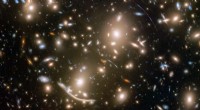
One recent observation that has raised new questions about the expansion of the universe is the discovery of multiple views of an exploding star. This star, called SN 2018gv, was observed by the Hubble Space Telescope and other telescopes in 2018. The observations revealed that the star exploded in a series of concentric rings, which were expanding at different speeds.
The different expansion speeds of the rings in SN 2018gv suggest that the universe may not be expanding at a constant rate. Instead, it may be expanding at an accelerating rate, but with the rate of acceleration changing over time. This would be a major challenge to our current understanding of the expansion of the universe.
Another possibility is that the different expansion speeds of the rings in SN 2018gv are due to the presence of dark matter. Dark matter is a hypothetical form of matter that does not interact with light or other electromagnetic radiation. However, it is thought to make up about 27% of the universe, and it could be responsible for the different expansion speeds of the rings in SN 2018gv.
The discovery of multiple views of SN 2018gv is a significant new observation that has raised new questions about the expansion of the universe. Further observations and research are needed to determine whether the universe is expanding at a constant or accelerating rate, and whether dark matter is responsible for the different expansion speeds of the rings in SN 2018gv.