A team of scientists from the University of Calgary has discovered what powers the mysterious celestial phenomenon known as STEVE.
STEVE, which stands for Strong Thermal Emission Velocity Enhancement, is a ribbon of glowing gas that appears in the night sky at high latitudes. It is typically seen during geomagnetic storms, and is often associated with the aurora borealis.
However, STEVE is different from the aurora borealis in several ways. It is much brighter, and it occurs at higher altitudes. Additionally, STEVE does not appear to be caused by the same processes that produce the aurora borealis.
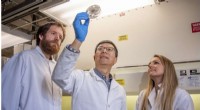
The University of Calgary team, led by Dr. Eric Donovan, used data from a number of sources, including satellites and ground-based observatories, to investigate STEVE. They found that STEVE is powered by a combination of two different processes:
* Joule heating: This is the process by which the flow of electric current through a conductor generates heat. In the case of STEVE, the electric current is flowing through the ionosphere, the layer of the atmosphere that is ionized by the sun's radiation.
* Collisional de-excitation: This is the process by which the energy of excited atoms and molecules is transferred to other particles through collisions. In the case of STEVE, the excited atoms and molecules are created by Joule heating, and they transfer their energy to the surrounding gas through collisions.
The combination of these two processes produces the bright ribbon of glowing gas that is characteristic of STEVE.
Dr. Donovan and his team's discovery is a major breakthrough in our understanding of STEVE. It is the first time that scientists have been able to identify the processes that power this mysterious celestial phenomenon.
This discovery is also significant because it may help us to better understand other space weather phenomena, such as the aurora borealis and geomagnetic storms.