1. Gravitational Collapse:
- A massive cloud of gas and dust, called a molecular cloud, undergoes gravitational collapse under the influence of its own gravity.
- This collapsing cloud forms a dense core, known as the protostar, at its center.
2. Fragmentation and Disk Formation:
- The protostar continues to accumulate material from the collapsing molecular cloud.
- As it grows in mass, the protostar begins to rotate rapidly, causing it to flatten into a disk shape.
- This rotating disk is known as the protoplanetary disk.
3. Dust and Gas Accretion:
- The protoplanetary disk consists of gas, dust, and small particles.
- Dust particles collide with each other and stick together, gradually growing in size through a process called coagulation.
- Over time, these particles can form larger bodies known as planetesimals, which are the building blocks of planets.
4. Orbital Dynamics and Planet Formation:
- The planetesimals in the protoplanetary disk interact gravitationally with each other and with the central protostar.
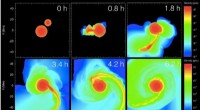
- Through processes like gravitational scattering, collisions, and mergers, the planetesimals start to organize into orbits around the protostar.
- Some planetesimals become gravitationally dominant, accumulating more and more material, eventually forming planets.
5. Core Formation and Differentiation:
- As the planets grow in size and mass, their gravitational pull increases, allowing them to accumulate even more material.
- The largest planets, known as "cores," can reach substantial sizes and begin to differentiate internally.
- They develop a metallic core, surrounded by a silicate mantle and an outer crust.
6. Gas Accretion and Atmospheres:
- While the cores of planets are forming, they continue to accrete gas from the surrounding protoplanetary disk.
- This gas builds up the planets' atmospheres, although some of the gas may be lost due to various processes such as photoevaporation or the effects of the central star's radiation.
7. Clearing of the Protoplanetary Disk:
- Over time, the protoplanetary disk is gradually depleted as the planets and other objects within the system interact with it.
- This eventually clears out the disk, leaving behind the central star orbited by its planets, forming the final planetary system.
During these processes, several factors can influence the properties of the planets that form, including the mass and composition of the protoplanetary disk, the temperature and density gradients within the disk, the presence of turbulent flows, and the effects of nearby stars or other external influences.