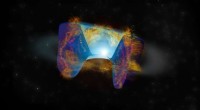
When massive stars reach the end of their lives, they undergo a cataclysmic explosion known as a supernova. This event marks the death of the star and the birth of a new cosmic object, such as a neutron star or a black hole. In recent years, scientists have been studying a fascinating phenomenon that occurs just before a supernova - the emission of pre-supernova neutrinos. These subatomic particles offer valuable insights into the processes leading up to a star's final moments.
Neutrinos: The Elusive Messengers
Neutrinos are among the most abundant particles in the universe, yet they are incredibly difficult to detect due to their ghostly nature. They have no electric charge and interact very weakly with matter, allowing them to pass through vast distances of space almost undisturbed. However, neutrinos carry crucial information about the environments they come from, making them invaluable probes for exploring the cosmos.
The Pre-Supernova Neutrino Signal
Observations of pre-supernova neutrinos provide scientists with a unique opportunity to study the conditions inside a massive star just before its collapse. These neutrinos are produced through various processes within the star's core, including nuclear reactions, electron capture, and pair-production. By detecting and analyzing these neutrinos, researchers can gain insights into the star's temperature, density, and the intricate dynamics at play during its final stages.
Recent Research Advancements
Recent advancements in neutrino detection technologies have enabled scientists to make significant progress in studying pre-supernova neutrinos. The IceCube Neutrino Observatory, located at the South Pole, has played a crucial role in detecting high-energy neutrinos from astrophysical sources. Other experiments, such as the Super-Kamiokande detector in Japan and the Borexino detector in Italy, have also contributed to our understanding of these elusive particles.
Neutrinos and Supernova Early Warning System
The detection of pre-supernova neutrinos holds the potential for developing a supernova early warning system. If scientists can successfully predict the timing and location of a nearby supernova, it would provide valuable opportunities for astronomical observations and the study of the event's aftermath. Such a system would revolutionize our understanding of stellar evolution and the birth of new cosmic objects.
Challenges and Future Prospects
Despite the progress made in studying pre-supernova neutrinos, significant challenges remain. The rarity of supernova events and the faintness of the neutrino signal make it difficult to obtain conclusive data. Advances in detector technology and international collaborations are crucial to overcome these challenges and deepen our understanding of the pre-supernova phase.
In conclusion, the study of pre-supernova neutrinos offers a unique window into the final moments of massive stars before their explosive deaths. By harnessing the power of neutrino detectors and international collaborations, scientists are pushing the boundaries of our knowledge and unraveling the secrets that lie hidden within these cataclysmic events.