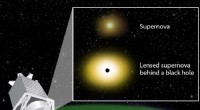
To weigh a star using gravitational lensing, astronomers first need to find a background object that is located behind the star. This background object can be a galaxy, a quasar, or even another star. Once a suitable background object has been found, astronomers can use telescopes to measure the amount of distortion or magnification that is caused by the star's gravity.
There are two main methods for measuring the distortion or magnification caused by gravitational lensing:
* Astrometry: Astrometry is the precise measurement of the positions of objects in the sky. By measuring the positions of the background object before and after it passes behind the star, astronomers can calculate the amount of distortion that has occurred.
* Photometry: Photometry is the measurement of the brightness of objects in the sky. By measuring the brightness of the background object before and after it passes behind the star, astronomers can calculate the amount of magnification that has occurred.
Once the distortion or magnification has been measured, astronomers can use a variety of mathematical techniques to calculate the mass of the star. The mass of the star is proportional to the amount of distortion or magnification that is caused by its gravity.
Gravitational lensing has been used to weigh a variety of stars, including the Sun, other stars in our galaxy, and stars in other galaxies. By measuring the masses of stars, astronomers can learn more about their structure, evolution, and place in the universe.
Here is a step-by-step guide to how astronomers weigh stars using gravitational lensing:
1. Find a background object that is located behind the star.
2. Measure the amount of distortion or magnification that is caused by the star's gravity.
3. Use mathematical techniques to calculate the mass of the star.
Gravitational lensing is a powerful tool that has allowed astronomers to learn more about the masses, structures, and evolutions of stars.