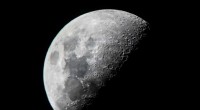
The Moon had a magnetic field in the past, but it disappeared around 3 billion years ago. Scientists have long debated the reason for this disappearance, and some have even proposed that it could be due to the Moon's collision with a giant impactor.
The new study, led by researchers from the University of California, Santa Cruz, suggests that the Moon's magnetic field may have disappeared as a result of a process called "core freezing." Core freezing occurs when the molten iron at the center of a planet or moon cools and solidifies. As the core cools, it loses its ability to generate a magnetic field.
The researchers believe that the Moon's core may have begun to freeze around 4 billion years ago, and that the magnetic field may have completely disappeared by around 3 billion years ago. This timeline would coincide with the emergence of the first complex life forms on Earth.
The researchers suggest that the Moon's magnetic field may have played a critical role in protecting Earth from harmful solar radiation during its early history. Without the Moon's magnetic field, Earth would have been more vulnerable to solar radiation, which could have damaged the DNA of early life forms and prevented their development.
The study's findings provide new insights into the early history of the Earth and the Moon, and they suggest that the Moon's magnetic field may have been essential for the development of life on Earth.
The Moon's magnetic field would have created a region of space around Earth called a "magnetosphere." The magnetosphere would have deflected solar radiation away from Earth, protecting it from the harmful effects of this radiation.
Solar radiation is a type of electromagnetic radiation that comes from the sun. It includes a wide range of wavelengths, from visible light to ultraviolet light and X-rays. Solar radiation can damage DNA, which can lead to mutations and cancer.
The Moon's magnetic field would have deflected most of the harmful solar radiation away from Earth, creating a safe haven for life to develop. Without the Moon's magnetic field, Earth would have been much more exposed to solar radiation, and it is unlikely that life would have been able to develop.
The Moon's magnetic field disappeared around 3 billion years ago. This was a critical time in the history of life on Earth, as the first complex life forms were just beginning to emerge.
The disappearance of the Moon's magnetic field may have had a significant impact on the development of life on Earth. It may have made Earth more vulnerable to solar radiation, which could have damaged the DNA of early life forms and prevented their development.
However, it is also possible that the disappearance of the Moon's magnetic field may have had a positive effect on the development of life on Earth. It may have allowed for the emergence of new life forms that were better adapted to the harsh conditions on Earth.
The exact impact of the Moon's magnetic field on the development of life on Earth is still unknown. However, the new study provides strong evidence that the Moon's magnetic field may have played a critical role in the emergence of complex life on Earth.