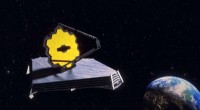
The James Webb Space Telescope (JWST) is the world's most powerful space telescope, designed to study the most distant objects in the universe, including the earliest stars and galaxies, and to search for exoplanets, which are planets outside our solar system.
One of the primary goals of the JWST is to find and characterize Earth-like exoplanets that may be habitable for life. The telescope is equipped with a near-infrared camera (NIRCam) and a mid-infrared instrument (MIRI), which are sensitive to the faint light emitted by cool, rocky planets like Earth.
The JWST is able to detect exoplanets by using a technique called transit photometry. When an exoplanet passes in front of its host star, as seen from Earth, it causes a slight dip in the star's brightness. By measuring the depth and duration of these transits, astronomers can determine the size and orbit of the exoplanet.
In addition to detecting exoplanets, the JWST can also study the atmospheres of these planets. By analyzing the light that passes through an exoplanet's atmosphere, astronomers can determine its composition and look for signs of molecules that could be associated with life, such as water, methane, and oxygen.
The JWST is expected to make significant contributions to our understanding of exoplanets and their potential for habitability. It is likely to discover thousands of new exoplanets, including Earth-sized planets in the habitable zones of their stars, where conditions may be just right for liquid water to exist on the surface.
The telescope is also expected to provide detailed information about the atmospheres of these exoplanets, helping us to determine whether they could potentially support life. The launch of the JWST in December 2021 marks a giant leap forward in our quest to understand our place in the universe and to find other Earths that could harbor life.