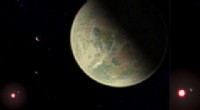
Hot Jupiters are a type of exoplanet that is characterized by its large size and close proximity to its star. These planets are often tidally locked, meaning that one side of the planet always faces the star, while the other side is always dark. Hot Jupiters are thought to be formed through a process called core accretion, in which a rocky core forms around a seed of gas and dust. The core then grows by accreting more gas and dust until it reaches its final size.
A new study by a team of astronomers from the University of California, Berkeley, has shed new light on the formation of hot Jupiters. The team used computer simulations to model the formation of these planets, and their results suggest that hot Jupiters may form more easily than previously thought.
The team's simulations showed that hot Jupiters can form in systems where the star is still in its early stages of development. This is in contrast to previous studies, which suggested that hot Jupiters could only form in systems where the star was more mature.
The team's findings also suggest that hot Jupiters may be more common than previously thought. This is because the conditions that are necessary for hot Jupiters to form are more common in young star systems.
The team's study provides new insights into the formation of hot Jupiters. These insights may help astronomers to better understand the diversity of exoplanets that exist in the universe.
Additional information:
* Hot Jupiters are typically gas giants, with masses that are several times that of Jupiter.
* Hot Jupiters orbit their stars very closely, with orbital periods of only a few days.
* The surface temperatures of hot Jupiters can be extremely high, reaching up to several thousand degrees Celsius.
* Hot Jupiters are thought to be relatively rare, with only a few hundred known to exist.