Introduction:
Gravity, the fundamental force that shapes the cosmos, holds the power to provide astronomers with a unique and powerful tool: gravitational lensing. This phenomenon, predicted by Albert Einstein's theory of general relativity, has revolutionized our understanding of the universe, offering scientists a cosmic microscope to study distant galaxies, black holes, and other mysterious objects. Let's explore how gravity acts as a lens, magnifying and distorting light, and how astronomers harness this effect to unravel the secrets of the universe.
The Essence of Gravitational Lensing:
Gravitational lensing occurs when the gravitational field of a massive object, such as a galaxy cluster or a black hole, bends and focuses the light from objects behind it. This effect is similar to how a magnifying glass bends light to enlarge an image. The more massive the intervening object, the stronger the gravitational lensing effect.
Magnification and Distortion:
Gravitational lensing acts as a natural "zoom lens" in space, magnifying the light from distant galaxies, quasars, and other luminous objects. By carefully studying these magnified images, astronomers can gain insights into the properties and structures of distant celestial objects that would otherwise be too faint or too small to observe. Additionally, gravitational lensing can distort the shapes of galaxies and produce intriguing optical illusions, providing valuable clues about the distribution of mass in the universe.
Mapping Dark Matter:
One of the most significant applications of gravitational lensing is its ability to detect and map the distribution of dark matter, an elusive and mysterious substance that makes up about 27% of the universe's total mass-energy. By analyzing the distortions and magnifications caused by gravitational lensing, astronomers can infer the presence and distribution of dark matter, providing essential clues about its nature and role in shaping the universe's structure.
Finding Black Holes:
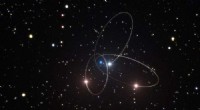
Gravitational lensing has proven to be a powerful tool in detecting and studying black holes, including supermassive black holes residing at the centers of galaxies. By observing the distortions of light around these massive objects, astronomers can estimate the black holes' masses and gain insights into their growth and evolution.
Exploring Cosmic Distances:
Gravitational lensing also offers a unique method to measure cosmic distances with high precision. By comparing the magnified images of distant objects with their known physical properties, astronomers can calculate the distances to galaxies and other celestial bodies, helping to map the vast expanse of the universe.
Conclusion:
Gravity, the universal force that governs the cosmos, also grants astronomers a remarkable lens through which they can study the universe in unprecedented detail. Gravitational lensing empowers scientists to magnify distant objects, uncover the secrets of dark matter, detect black holes, and accurately measure cosmic distances. As we continue to explore the mysteries of the universe, gravitational lensing remains a vital tool, offering astronomers a unique perspective on the vast and intricate tapestry of the cosmos.