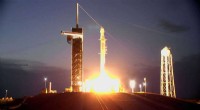
Falcon Heavy (SpaceX, USA):
- Payload Capacity: Up to 63,800 kg (140,660 lbs) to low Earth orbit.
- Features: Consists of three Falcon 9 booster rockets that launch together and can then separate. It is designed for heavy payloads such as satellites, space probes, and cargo missions to Mars and beyond.
Delta IV Heavy (United Launch Alliance, USA):
- Payload Capacity: Up to 28,790 kg (63,470 lbs) to low Earth orbit.
- Features: Consists of three common booster cores and a large payload fairing, suitable for launching geostationary satellites, deep-space probes, and planetary missions.
Atlas V 551 (United Launch Alliance, USA):
- Payload Capacity: Up to 18,800 kg (41,447 lbs) to low Earth orbit.
- Features: Powerful variant of the Atlas V rocket series with five solid rocket boosters, primarily designed for missions requiring heavier payloads.
Proton-M (Roscosmos, Russia):
- Payload Capacity: Up to 22,800 kg (50,265 lbs) to low Earth orbit.
- Features: Workhorse rocket of Russia, used for launching satellites, cosmonaut missions, and deep-space probes. It consists of a central core and six detachable outer boosters.
Long March 5 (China Aerospace Science and Technology Corporation (CASC), China):
- Payload Capacity: Up to 25,000 kg (55,115 lbs) to low Earth orbit.
- Features: China's largest and most powerful rocket to date, designed to launch heavy satellites, space stations, and exploration missions.
H-IIA (Mitsubishi Heavy Industries (MHI), Japan):
- Payload Capacity: Up to 15,000 kg (33,069 lbs) to low Earth orbit.
- Features: Multi-purpose Japanese launch vehicle used for satellite deployments, resupply missions to the International Space Station, and planetary missions.
Space Launch System (NASA/United Launch Alliance, USA):
- Payload Capacity: Up to 130,000 kg (286,600 lbs) to low Earth orbit.
- Features: Under development, it will be the most powerful rocket ever built, designed for missions such as Artemis program lunar missions and deep space exploration.
It's worth noting that advancements and new rocket developments are ongoing, and there might have been updates to the capabilities of some rockets or the emergence of new competitors since my last knowledge update. For the most current and accurate information, it is always best to refer to official sources or reputable aerospace news websites.