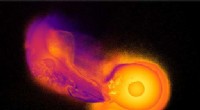
However, recent observations have unveiled that such systems can indeed be the birthplaces of planets. Observations and computer simulations have now given theoretical insights into how planet formation in binary star systems can happen.
A team led by Takashi Hosokawa of the Instituto de Astrofísica e Ciências do Espaço in Portugal used the Atacama Large Millimeter/submillimeter Array (ALMA) to observe two disks in a binary system with about three times the separation of Earth from the Sun. They discovered gaps and spirals within the disks at the locations of newborn exoplanets.
Another team, led by Keiichi Wada of Kagoshima University in Japan, used computer simulations to shed further light on the mechanism. They found that disk warping, a phenomenon where the inner and outer parts of the disc are not on the same plane, plays a crucial role in avoiding collisions with one of the stars.
These findings challenge our assumptions about planet formation and provide new insights into the diversity and complexity of planetary systems. Further observations and simulations will continue to refine our understanding of these processes and help us unravel the mysteries of planet formation in binary systems.