Primordial stars are the first stars that formed in the universe. They are thought to have been very massive and hot, and they would have emitted a lot of ultraviolet light. This light would have caused the surrounding gas to become ionized, creating a region of ionized gas known as an H II region. H II regions are often found around young stars, and they can be used to identify regions where star formation is taking place.
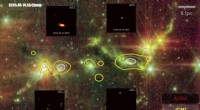
JWST is able to detect the infrared light emitted by H II regions, which means that it is well-suited to studying primordial stars. By observing H II regions, JWST may be able to identify galaxies made of primordial stars. This would provide important insights into the early universe and the formation of the first stars.
JWST is currently undergoing testing, and it is expected to be launched into space in 2021. Once it is in space, JWST will begin its mission to study the universe in infrared light. It is hoped that JWST will make many important discoveries, including the observation of galaxies made of primordial stars.