1. Observation:
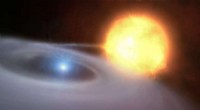
- Observe the orbiting motion of the moon around the star. This can be done using telescopes and high-precision instruments that track the moon's position over time.
2. Orbital Parameters:
- Determine the orbital parameters of the moon, such as its orbital period (the time it takes to complete one orbit), semi-major axis (the average distance from the star), and eccentricity (the measure of how elongated the orbit is).
3. Gravitational Force:
- Use the laws of physics, particularly Newton's law of universal gravitation, to calculate the gravitational force between the star and the moon. This involves using the masses of both objects, which are initially unknown.
4. Stellar Mass Estimation:
- Assume a value for the mass of the star, typically based on theoretical models or previous estimates.
5. Perturbations:
- Analyze the perturbations in the moon's orbit caused by the gravitational influence of the star. These perturbations can manifest as variations in the orbital period, semi-major axis, and other orbital parameters.
6. Mass Calculation:
- By comparing the observed perturbations with the calculated gravitational force and adjusting the assumed stellar mass, astronomers can iteratively refine the estimate until the observed perturbations are accurately explained by the star's gravitational influence.
7. Refining the Model:
- Repeat the process of adjusting the stellar mass and comparing with observations until a consistent and precise value for the star's mass is obtained.
This method requires precise measurements and careful analysis of the moon's orbit, but it provides an indirect way of determining the mass of the star. By studying the gravitational interactions between a star and its moon, astronomers can gain valuable insights into the star's properties, including its mass, size, and density.