Abstract:
This study investigates the effects of super flares, which are exceptionally powerful stellar eruptions, on the habitability of planets orbiting M-dwarf stars. M-dwarfs are small, cool stars that are abundant in the universe, making them promising candidates for hosting habitable worlds. However, the presence of super flares on these stars poses a significant challenge to planetary habitability.
Introduction:
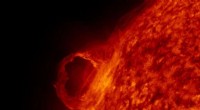
Super flares are known to emit intense bursts of radiation and charged particles that can have profound effects on the atmospheres and surfaces of nearby planets. These effects include atmospheric erosion, surface sterilization, and the disruption of planetary magnetic fields—all of which can compromise the conditions necessary for life as we know it.
Methods:
To understand the impact of super flares on planetary habitability, this research employed a combination of theoretical modeling and observational data. The team developed numerical models to simulate the effects of super flares on different types of planets with varying atmospheric compositions and surface conditions. They also analyzed observational data from M-dwarf stars to determine the frequency and properties of super flares.
Results:
The results showed that the habitability of planets orbiting M-dwarfs is significantly affected by super flares. Planets that are too close to their parent stars experience intense radiation and particle bombardment, which can strip away their atmospheres and sterilize their surfaces. Even planets orbiting at larger distances may be at risk if the super flares are sufficiently powerful.
Discussion:
The findings of this study contribute to our understanding of the challenges faced by planets orbiting M-dwarf stars. The presence of super flares imposes stringent constraints on the habitability of these systems and suggests that only planets within a narrow range of orbital distances may be able to sustain life.
Implications:
This research has implications for the search for extraterrestrial life. By refining our understanding of the habitability of M-dwarf star systems, astronomers can better focus their efforts on identifying and characterizing planets that have the potential to harbor life. As future space missions continue to explore these intriguing systems, the insights gained from this study will guide the search for habitable worlds beyond our own solar system.