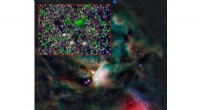
1. Interstellar Dust and Gas: Microscopic organisms or organic molecules could be trapped within interstellar dust and gas clouds and carried by stellar winds or supernova explosions. These clouds can travel vast distances and potentially seed life to other planetary systems.
2. Planetary Ejection: In the early stages of planetary formation, violent events like giant impacts or gravitational interactions can eject small rocky fragments from planetary systems. These fragments, known as "planetesimals," could potentially carry viable microorganisms to other star systems.
3. Interstellar Ice: Organic molecules can be preserved within icy bodies, such as comets and interstellar ice grains. As comets and interstellar ice travel through the galaxy, they could potentially distribute these organic molecules to other planetary systems.
The transport mechanisms mentioned above depend on various factors, such as the temperature and radiation conditions in space, the ability of microorganisms to survive these harsh conditions, and the likelihood of these transport vectors encountering suitable environments for life.
While the concept of galactic panspermia is intriguing, it remains speculative and challenging to confirm. The vast distances between stars, the harsh conditions of space, and the difficulties in detecting extraterrestrial life make it challenging to conclusively demonstrate the transfer of life between star systems.
Additionally, even if life could be transported between star systems, it faces the further challenge of finding suitable conditions for survival and initiating sustained reproduction on a new planet.
While galactic panspermia remains a subject of scientific interest and exploration, much more research and empirical evidence are needed to substantiate this hypothesis and understand the potential for life's dissemination throughout galaxies.