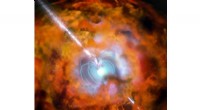
1. Rapid Gas Accretion: One of the primary mechanisms is rapid gas accretion onto the central black hole. As gas falls towards the black hole, it forms an accretion disk, which heats up due to friction and releases enormous amounts of energy. This process leads to the rapid growth of the black hole. The gas can come from various sources, such as mergers of smaller galaxies or inflows of gas from the intergalactic medium.
2. Mergers and Collisions: Another factor contributing to the growth of SMBHs is the mergers and collisions of galaxies. When galaxies merge, their central black holes can also merge, leading to a significant increase in mass. This process is particularly efficient in dense environments where galaxy mergers are more common.
3. Eddington-Limited Accretion: The Eddington limit refers to the maximum rate at which a black hole can accrete matter without blowing away the surrounding gas due to radiation pressure. However, some SMBHs are observed to be accreting at or even above the Eddington limit. This suggests that additional mechanisms, such as the presence of a massive disk or outflows, may help the black hole to overcome the Eddington limit and continue growing rapidly.
4. Feedback Processes: The growth of SMBHs can also be influenced by feedback processes. As SMBHs accrete matter, they can release vast amounts of energy in the form of jets and outflows. These outflows can heat up the surrounding gas, preventing further accretion onto the black hole. This self-regulating mechanism may play a role in controlling the growth of SMBHs.
5. Primordial Black Holes: Some theories propose that supermassive black holes may have originated as primordial black holes formed in the very early universe. These primordial black holes could have grown through mergers and accretion to become the massive black holes we observe today.
It is likely that a combination of these mechanisms contributed to the rapid growth of supermassive black holes in the early universe. Further observations and theoretical studies are necessary to fully understand the processes responsible for the growth of these massive objects.