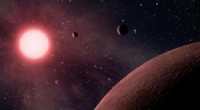
Named TOI 5205b, the Neptune-sized gas giant is on a wildly eccentric path around a Sun-like star, swinging from a distance of 60 million miles (100 million km) to 200 million miles (320 million km) away every 111 days.
This highly elongated orbit and the planet's relatively low mass of about 38 Earth masses are helping astronomers shed light on the poorly understood period of adolescence in the lives of gas giants. In particular, TOI 5205b's strange orbit hints that the planet's formation was interrupted, possibly by an encounter with another giant planet in its system, which scattered the growing planet's rocky core and disrupted the accumulation of gas from its natal disk.
"This is one of the most extreme giant planets we've seen to date," said astronomer Jessica Libby-Roberts of The University of Texas at Austin, lead author of the study published in The Astrophysical Journal Letters.
"It's a very challenging object to fit into our current models of how gas giants form and evolve."
As its name implies, the Transiting Exoplanet Survey Satellite (TESS) mission originally detected TOI 5205b in 2021. While examining light curves from this space-based hunter of small dips in a star's brightness caused by orbiting exoplanets, Libby-Roberts noticed that the planet's transits were too short and spaced strangely far apart given the system's estimated orbital period.
"In the TESS alert we got, it said the period was about 20 days or something, and right away that didn't seem right just from looking at the light curves," Libby-Roberts said. "They looked much more consistent with a period of about 111 days, so that got me excited."
Follow-up ground-based observations gathered by Libby-Roberts and colleagues using high-resolution spectrographs, which study an object's absorption and emission of light, confirmed the system's true orbital period. Those measurements also refined the planet's mass, which is important for understanding its density, along with other clues to TOI 5205b's evolutionary path.
Current theories suggest that giant gas planets like Jupiter or Saturn form from accumulations of ice, dust, and organic molecules in the cold reaches of a protoplanetary disk — the rotating platter of material that surrounds a young star and out of which planets are born.
Once the solid core builds up to about 10 times the mass of Earth, it becomes massive enough to attract a puffy envelope of gas from its surroundings. The more massive the gas envelope becomes, the more gas it attracts through gravitational pull. This runaway process is what allows some planets to grow into giants.
As TOI 5205b's estimated age is approximately 100 million years, it offers scientists an opportunity to directly study this “runaway gas accretion” process and probe the conditions of a giant planet's adolescence.
However, TOI 5205b's oddball orbit poses a challenge to simple core accretion scenarios, which predict smooth, nearly circular orbits. Astronomers think encounters between giant planets might be a common occurrence during exoplanet formation, influencing their development and altering their orbital paths. In the case of TOI 5205b, simulations suggest the planet likely started on a fairly circular orbit but experienced a close encounter with another giant planet in the system about 10 million years ago.
This gravitational interaction significantly scattered TOI 5205b's rocky core and disrupted the planet's smooth gas accumulation, resulting in its lower mass and eccentric orbit.
"I've thought about this system so much, and I have so many more questions," Libby-Roberts said. "I'm really looking forward to future studies to understand more about the dynamics and history of the system and how it ended up with this very eccentric orbit."
Libby-Roberts and colleagues plan to look for additional planets in the system and observe TOI 5205b in other wavelengths, such as infrared, to better understand the planet's atmosphere, composition, and the amount of starlight it reflects.