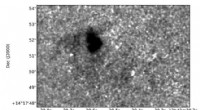
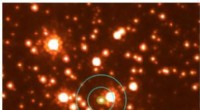
Despite not having prominent rings like other planets, Earth does have a faint ring of debris located in a specific region known as the Lagrange point L4. The L4 point is located 60 degrees ahead of Earth in its orbit around the Sun. At this point, the gravitational forces from Earth, the Sun, and the Moon balance out, allowing for the stable accumulation of debris.
This ring of debris, sometimes called the "Kordylewski Cloud" or the "Earth Cloud," is composed mainly of dust particles and small meteoroids. The particles are loosely concentrated in a region about 100,000 kilometers in diameter and are constantly replenished through collisions and gravitational interactions.
Unlike the spectacular rings of other planets that are visible from Earth-based telescopes, Earth's debris ring is much less dense and requires special observations and instruments to be detected. Its composition is also unique, with a larger proportion of cosmic dust compared to the icy particles found in the rings of gas giants.
While the Earth's ring may not be as visually striking or well-known as those of other celestial bodies, its existence highlights the dynamic nature of our Solar System and provides insights into the intricate interactions and dynamics that shape the environments of planets and other cosmic structures.