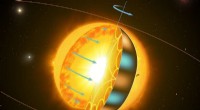
How do black holes form?
Black holes are formed when a star dies. When a star reaches the end of its life, it collapses under its own gravity. If the star is massive enough, the collapse will create a black hole.
The more massive the star, the larger the black hole will be. The smallest black holes are only a few times the mass of the Sun, while the largest black holes can be billions of times more massive.
What happens inside a black hole?
The inside of a black hole is a region of spacetime known as a singularity. The singularity is a point of infinite density and gravity. It is impossible to know what happens inside the singularity, as no information can escape from it.
The event horizon
The event horizon of a black hole is the boundary beyond which nothing can escape. If you cross the event horizon, you will be pulled into the black hole and will never be able to escape.
The event horizon is a real physical boundary, not just a mathematical concept. It is caused by the curvature of spacetime around the black hole.
Black holes and the universe
Black holes play an important role in the universe. They are thought to be responsible for the formation of galaxies and the growth of supermassive black holes.
Black holes are also a source of energy. When matter falls into a black hole, it is heated to extremely high temperatures and emits a powerful jet of particles. These jets can travel across the universe and can be used to probe the deepest secrets of black holes.
Black holes are a fascinating and mysterious part of the universe. They are a reminder that there is still much that we do not know about the cosmos.