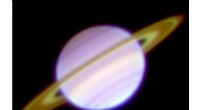
The images were obtained using Cassini's ultraviolet imaging spectrograph (UVIS) during multiple observing sessions between December 2011 and April 2012. While studying Saturn's upper atmosphere, the UVIS instrument serendipitously captured these auroral displays in the planet's northern hemisphere.
The northern lights, also called aurora borealis on Earth, occur when energetic charged particles interact with gases in a planet's atmosphere, causing them to glow. In the case of Saturn, these charged particles originate from the planet's powerful magnetosphere, which forms due to the interaction of Saturn's magnetic field and the solar wind.
The auroral emissions that took place in Saturn's northern hemisphere during the Cassini observations stretched for thousands of kilometers, forming complex and intricate patterns. Some of these patterns even resembled the shape of a hexagon, a distinctive feature associated with Saturn's global-scale atmospheric circulation.
The images revealed a dynamic auroral system on Saturn, with auroral features forming, evolving, and changing in a matter of minutes. These observations provide valuable insights into the processes that drive auroral activity on the planet and help scientists understand the behavior of Saturn's atmosphere and magnetic field interaction.
This series of images captured by Cassini serves as a testament to the mission's remarkable contributions to the scientific exploration of Saturn and its surroundings. While the Cassini spacecraft concluded its historic journey by intentionally plunging into Saturn's atmosphere in 2017, the wealth of data and observations it collected continues to provide scientists with a better understanding of this enigmatic gas giant and the wonders of our solar system.