1. Direct Observation of Protoplanetary Disks:
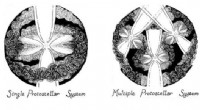
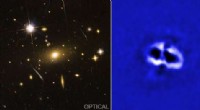
- Scientists use powerful telescopes, both ground-based and space-based, to directly observe protoplanetary disks surrounding young stars. These disks are the birthplaces of planets and consist of gas, dust, and other materials.
2. Spectroscopy:
- Spectroscopic analysis of the light coming from protoplanetary disks provides information about their composition and temperature. Different elements and molecules emit or absorb specific wavelengths of light, allowing astronomers to identify the materials present in the disk.
3. Polarimetry:
- Polarimetry involves analyzing the polarization of light from a protoplanetary disk. This technique can reveal the presence of dust grains and their alignment, providing clues about the disk's structure and dynamics.
4. Atacama Large Millimeter/Submillimeter Array (ALMA):
- ALMA is a powerful radio telescope array located in Chile that operates in the millimeter and submillimeter wavelength range. It has significantly enhanced our ability to observe and study cold gas and dust in protoplanetary disks, providing detailed images of planet-forming regions.
5. Space Probes and Missions:
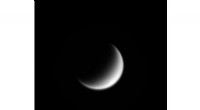
- Spacecraft missions, such as NASA's Cassini-Huygens mission to Saturn and the Juno mission to Jupiter, have provided close-up observations and data from within planetary systems. These probes can study the composition, structure, and dynamics of protoplanetary disks and the planets within them.
6. Computer Simulations:
- Theoretical models and computer simulations play a crucial role in studying planet formation. Scientists use simulations to recreate the physical processes involved in planet formation and to test different scenarios and theories. These simulations help us understand how planets grow, interact, and evolve over time.
7. Transit Photometry:
- Transit photometry involves observing dips in the brightness of a star caused by a planet passing in front of it (a transit). By measuring the depth and duration of these transits, astronomers can infer the size and orbital characteristics of the planet.
8. Microlensing:
- Microlensing is a technique used to detect planets by observing the gravitational distortion of light from a background star caused by the passage of a planet in front of it. This method can detect planets that are too far away to be directly imaged.
By combining these observational techniques, theoretical models, and advanced instrumentation, scientists continue to unravel the mysteries of planet formation and gain insights into the birth and evolution of our own solar system and those of other stars.