1. Look for Active Galactic Nuclei (AGN):
- AGN are the central regions of galaxies that emit immense energy due to the presence of a supermassive black hole.
- The black holes in these AGN can be rapidly spinning, generating powerful jets of matter.
2. Observe Jet Speeds:
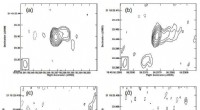
- Studying the jets ejected from AGN can provide insights into the black hole's spin.
- Extremely high jet speeds indicate the presence of a rapidly spinning black hole.
3. Spectral Analysis:
- Analyze the electromagnetic radiation emitted by the AGN.
- The emission lines in the spectrum can reveal information about the black hole's rotation rate.
4. X-ray Variability:
- Rapid variations in X-ray emission from an AGN can indicate the presence of a fast-spinning black hole.
- These variations are caused by changes in the accretion disk around the black hole.
5. Optical Polarization:
- The light emitted from the accretion disk can be polarized due to the strong gravitational field of the black hole.
- The degree of polarization can be linked to the black hole's spin.
6. Relativistic Effects:
- Observe phenomena such as frame-dragging (Lense-Thirring effect) and black hole shadows.
- These effects are influenced by the black hole's rotation and can provide clues about its speed.
7. Gravitational Waves:
- Gravitational wave observations from merging black hole systems can provide information about their spins.
- The faster the black holes are spinning, the stronger the gravitational wave signals.
8. Numerical Simulations:
- Use computer simulations to model the behavior of rapidly rotating black holes.
- These simulations can help understand the characteristics and properties of these extreme objects.
9. Multi-wavelength Observations:
- Combine observations across different wavelengths, from radio to X-rays, to obtain a comprehensive understanding of the black hole's properties.
- Multi-wavelength data can reveal different aspects of the black hole's behavior.
10. Long-term Monitoring:
- Monitor AGN over extended periods to capture variability and changes in their properties.
- Long-term observations can help identify persistent or transient fast-spinning black holes.
By employing these techniques and analyzing multiple observational data, astronomers can identify and study the speediest black holes that exist in the vastness of the universe.