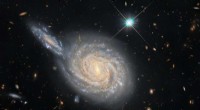
Supermassive black holes, the largest black holes in the Universe, are thought to reside in the centers of most galaxies. When galaxies collide, their central black holes are also brought together, eventually settling into a binary pair. As these binary black holes spiral towards each other, they emit powerful gravitational waves, ripples in the curvature of spacetime. In 2015, the Laser Interferometer Gravitational-Wave Observatory (LIGO) detected the first gravitational waves from a merging binary black hole pair.
How exactly supermassive black holes form pairs during galaxy mergers has, until now, been poorly understood. A team of researchers from the Center for Computational Astrophysics (CCA) at the Flatiron Institute in New York City carried out numerical simulations to investigate this problem. The results, published in the journal Physical Review Letters, show how supermassive black holes become gravitationally bound during the chaotic aftermath of a galactic collision.
The researchers used a technique called Smoothed Particle Hydrodynamics to follow the complex motions of the gas and stars that make up galaxies during a collision. They found that after two disk galaxies merge, their supermassive black holes form a binary pair, even when the black holes started out relatively far apart. This happens because the stars and gas in the galaxies act as a kind of glue, holding the black holes together through their gravitational interactions.
“Our simulations show how supermassive black holes form bound pairs during galaxy mergers, which is a necessary step for them to eventually merge and emit gravitational waves. The LIGO observations of gravitational waves from merging black holes are thus providing indirect insights into the dynamics of galaxy mergers,” said Volker Springel, a CCA Member and Professor of Astrophysics at the Heidelberg Institute for Theoretical Studies.
The simulations show that galaxies with more stars and gas are able to bind their supermassive black holes into tighter binary pairs than galaxies that are less dense. The properties of the binary black holes that are produced in these simulations are in agreement with the observations of binary black holes that have been made by LIGO.
This research provides important insights into the physics of galaxy mergers. These insights will be crucial for detecting and interpreting future gravitational wave signals from merging black holes, and for understanding the evolution of galaxies over time.