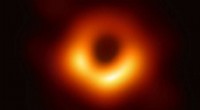
The event, known as a tidal disruption event (TDE), occurred about 375 million light-years from Earth. It was observed by the Burst Alert Telescope (BAT) aboard NASA's Swift satellite on January 21, 2020.
Swift's BAT detected a burst of X-rays, which triggered follow-up observations by Chandra, the European Space Agency's (ESA) XMM-Newton X-ray observatory, and several ground-based telescopes.
The observations revealed a rapidly evolving source of X-rays and ultraviolet light, which the astronomers determined was a TDE. In a TDE, a star passes too close to a black hole and is torn apart by the black hole's gravitational forces.
The observations also showed that the black hole was spinning rapidly, and that the star was likely a red supergiant, a large, cool star that is nearing the end of its life.
"We were able to catch this TDE early, which allowed us to study the process in unprecedented detail," said Dacheng Lin of the University of New Hampshire, Durham, lead author of a study describing the results in the journal Nature.
The astronomers found that the black hole was spinning at about 100,000 kilometers per second, or about 360,000 miles per hour. This is about one-third the speed of light. The black hole is also about 100 million times more massive than the Sun.
The star that was torn apart by the black hole was about 10 times more massive than the Sun. When the star passed close to the black hole, the black hole's gravitational forces ripped it apart into a stream of gas and dust. This stream of material swirled around the black hole, emitting X-rays and ultraviolet light.
"This is a remarkable example of how black holes can shred nearby stars," said co-author Erin Kara of the University of Maryland, College Park. "We're lucky to have been able to catch this event so early, as it gives us a rare glimpse into the violent process of stellar destruction."
The astronomers plan to continue observing the TDE to learn more about how black holes interact with nearby stars. They hope that future observations will help them to better understand the role of TDEs in the evolution of galaxies and black holes.