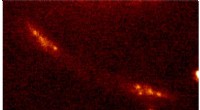
A telescope in Hawaii has detected what could be the oldest galaxy yet: a faint smudge of light formed some 13.4 billion years ago. If confirmed, the discovery would provide a deeper glimpse into the cosmos than ever before and add more detail to an already complicated jigsaw puzzle about how the universe developed in the wake of the Big Bang. “This could potentially reshape our current picture of galaxy formation by revealing much earlier objects than previous surveys,” Akio Inoue of Waseda University in Tokyo said in a news release. Inoue is the first author of a pair of papers detailing the work with the Subaru telescope that are set to be published in an upcoming volume of the journal Astrophysical Journal Letters. The work has not yet been subject to outside, peer-reviewed scrutiny typical in most scientific disciplines. The galaxy candidate sits 28 billion light-years from Earth—so distant that we see how it appeared when the universe was less than 1 billion years old, Inoue said. The team estimated the light was emitted a scant 380 million years after the Big Bang. The universe is now more than 13.8 billion years old. The first stars are thought to have formed as early as about 250 million years after the birth of the universe in what astronomers call the epoch of “reionization,” so if this candidate holds up to scrutiny, its detection suggests we are witnessing such cosmic activity even earlier and in ever greater detail, according to astronomer Yoshiaki Ono of Tohoku University in Japan. “With more and more discoveries of extremely distant sources, some basic features of this epoch seem to be slowly unraveled; however, more systematic data will help complete the grand picture with the Subaru’s contribution,” Ono told Astronomy.com via email. “Therefore, we will keep hunting down further faint sources with Subaru.” The observations with the Subaru Telescope and its infrared camera Hyper Suprime-Cam (HSC) took place between early March 2022 and December 2022 under an international observation program called the Ultra Deep Survey project (UDS) Legacy Subaru Measurement of Areas surrounding XMM-Newton Groups (MUSASHI). This program has also recently uncovered other promising galaxy candidates dating to between 900 million to 1.1 billion years following the Big Bang. Other telescopes will help confirm whether such early estimates bear out. The James Webb Space Telescope, an international mission led by NASA with the European and Canadian space agencies, might offer an even clearer picture through additional observations set for this late July, according to Astronomy.com.