With Gaia's precise measurements, astronomers have estimated the ages of more than 100 million stars and combined them with the stars' chemical composition to create the age map. The resulting tapestry of stellar ages unveils the intricate history of the Milky Way.
The map confirms the existence of multiple stellar populations within the Milky Way, each with its own age and chemical makeup. This indicates that our galaxy has experienced several distinct episodes of star formation over time. The map suggests that the oldest stars in the Milky Way are around 13 billion years old, nearly as ancient as the universe itself.
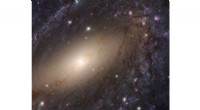
The map also reveals the structure of the Milky Way, showing that it consists of a central bulge, a disk, and a halo. The bulge, the oldest and most compact part of our galaxy, contains stars mostly older than 10 billion years. The disk, where our solar system resides, hosts stars of various ages, from very young to several billion years old. These stars are arranged in spiral arms, indicative of ongoing star formation. The halo, the vast outer region of the Milky Way, comprises mostly ancient stars that formed in the early stages of the galaxy's development.
The age map of the Milky Way provides valuable clues about the galaxy's formation and growth. The chemical composition of stars helps astronomers infer the conditions in which they formed. Stars that formed early in the Milky Way's history are more metal-poor than those that formed later, indicating a gradual enrichment of heavy elements through successive generations of star formation.
By studying the distribution and ages of stars in the Milky Way, astronomers can better understand the processes that have shaped our galaxy. This knowledge contributes to unraveling the mysteries of the universe and our place within it, ultimately piecing together the complex narrative of the Milky Way's grand evolutionary saga.