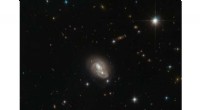
Double peanut shell galaxies are very rare, with only a few known to exist. They are characterized by their distinctive shape, which resembles two peanuts shells joined together. This shape is caused by the galaxy's two central black holes, which are orbited by two disks of stars.
The new imaging software, developed by astronomers at the University of California, Berkeley, allowed the researchers to detect the faint light emitted by the stars in LEDA 2046642. This allowed them to create a detailed image of the galaxy, revealing its unusual shape.
The discovery of LEDA 2046642 is important because it provides new insights into the formation and evolution of galaxies. Double peanut shell galaxies are thought to be the result of two smaller galaxies merging together, and the new imaging software allows astronomers to study these mergers in more detail.
The researchers plan to use the new imaging software to study other double peanut shell galaxies in order to learn more about these rare objects. They hope that this research will help them to better understand the formation and evolution of galaxies.