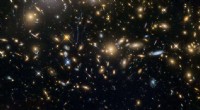
Galaxies are systems characterized by the presence of stars, stellar remnants, interstellar gas, dust and dark matter.
The researchers used data from the Sloan Digital Sky Survey to study a sample of 100,000 galaxies. They found that galaxies that have stopped creating stars have much lower levels of cold gas than galaxies that are still forming stars.
Cold gas is the raw material that is needed to form new stars. When a galaxy runs out of cold gas, it can no longer create new stars.
The researchers also found that galaxies that have stopped creating stars are more likely to be found in dense environments, such as galaxy clusters. This suggests that the environment can play a role in shutting down star formation in galaxies.
The findings of this study have important implications for our understanding of galaxy evolution. They help us to understand why some galaxies stop creating stars while others continue to form new stars.
The study was published in the journal The Astrophysical Journal.