The theory, published in the Monthly Notices of the Royal Astronomical Society, explains long-standing mysteries surrounding the chemical history and structure of the solar system, including the presence of rare isotopes in meteorites and the existence of water-rich planetesimals.
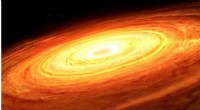
The astronomers modeled the conditions necessary for the formation of planetesimals—the small, rocky or icy bodies that eventually form planets—around a giant star, with a mass about twice of the Sun. They found that material falling onto the disk from interstellar space could become highly enriched with rare isotopes through a process known as photo-disintegration, in which high-energy radiation from the star is absorbed by elements causing them to release protons.
This enrichment matches the composition of meteorites that were likely delivered to the early Earth from beyond Neptune, and later recycled into Earth's mantle.
"Meteorites are our time capsules to understanding the origin and evolution of the solar system," said lead author Emily Mace, a Ph.D. candidate in the Department of Physics and Astronomy.
"These rare isotopes allow us to trace the chemical journey of material from the birth of our solar system up to meteorite impacts that deposited water-rich matter early in Earth's history."
One mystery the giant-star model solves is the existence of water-rich bodies like comets beyond Neptune. In the more conventional scenario of the solar system forming around a young Sun, it's difficult for volatile species such as water to condense within the protoplanetary disk. However, in a disk around a giant star, cooling occurs so rapidly that volatiles can condense beyond Neptune's orbit to help form water-rich planetesimals and comets.
"The presence of water-rich planetesimals at large distances from our infant Sun is exciting as it means Earth did not have to rely solely on local water sources—potentially allowing for life to arise earlier than previously thought," Mace said.
As the star ages and begins to fuse heavier elements, it pulsates and sheds mass rapidly, ultimately transforming into a planetary nebula. The intense radiation and stellar wind from this phase disperse most of the remaining gas within the inner disk.
"If you were standing on ancient Earth during this time, you might see intense ultraviolet auroras over the poles and a very bright star in the night sky as our host star pulsates and dies," Mace said.
While evidence for the bubble hypothesis remains elusive, the University of Rochester team believes that future missions may yet uncover traces of the giant progenitor star. Until large datasets with isotopic measurements of distant planetesimals become available, the theory will continue to evolve through detailed modeling and comparison to solar system observations.