Scientists believe that rogue planets form in one of two ways:
1. Ejected from their planetary system:
- During the early stages of planetary formation, a planet can be gravitationally ejected from its parent star system by interactions with other planets or by gravitational perturbations from nearby passing stars.
2. Failed stars:
- Some rogue planets may have formed as protostars, but failed to accumulate enough mass to ignite nuclear fusion in their cores. These objects are often referred to as brown dwarfs. Brown dwarfs can be difficult to detect due to their faint luminosities, and some of them may have cooled down and become rogue planets over time.
Characteristics of Rogue Planets
Rogue planets are characterized by several unique features that set them apart from planets orbiting stars:
1. Free-floating: Rogue planets do not orbit any star and instead wander freely through interstellar space.
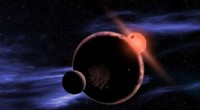
2. Dark and cold: Rogue planets do not emit their own light and rely on reflected sunlight or their internal heat for warmth. As they are far from any star, they are typically very cold, with surface temperatures below freezing.
3. Difficult to detect: Due to their faintness and lack of a parent star, rogue planets are extremely difficult to detect. Most of the known rogue planets have been discovered through indirect methods, such as gravitational microlensing or imaging of their faint thermal emissions.
4. Potential for habitability: Some rogue planets may have conditions suitable for supporting life, despite their isolation from a star. This could occur if they have a thick atmosphere that traps heat, or if they have internal heat sources such as geothermal activity. However, the study of potentially habitable rogue planets is still in its early stages, and many challenges remain in understanding their conditions.
Conclusion:
Rogue planets are fascinating and enigmatic objects that challenge our understanding of planetary formation and evolution. While much remains unknown about these wandering bodies, ongoing advancements in observational techniques and theoretical models are helping scientists unravel the mysteries of rogue planets and their place in the vast expanse of the cosmos.