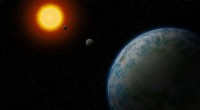
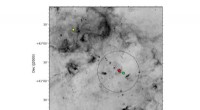
The James Webb Space Telescope (JWST) has captured stunning images of the earliest stages of star and planet formation, providing scientists with a new perspective on how these celestial bodies come into being.
One of the most striking images is of a star cluster called RCW 86, which is located about 9,000 light-years from Earth. The image shows a dense cloud of gas and dust that is being illuminated by the intense radiation from the young stars that are forming within it. The cloud is also riddled with dark filaments, which are thought to be dense clumps of material that are eventually compressed under gravity to form new stars.
Another image shows a protoplanetary disk, which is a swirling cloud of gas and dust that surrounds a young star. This disk is where planets will eventually form as the dust and gas clump together and accrete into larger and larger objects. The image shows a series of bright rings and gaps in the disk, which are thought to be caused by the presence of newborn planets.
These images are just a small sample of the incredible data that the JWST is sending back to Earth. The telescope is providing scientists with a unique opportunity to study the earliest stages of star and planet formation in unprecedented detail. This data is helping to shed light on some of the most fundamental questions about the universe, such as how stars and planets are born and how they evolve over time.
Here are some of the key features of the images:
* RCW 86 is a star cluster located about 9,000 light-years from Earth.
* The image shows a dense cloud of gas and dust that is being illuminated by the intense radiation from the young stars that are forming within it.
* The cloud is also riddled with dark filaments, which are thought to be dense clumps of material that are eventually compressed under gravity to form new stars.
* A protoplanetary disk is a swirling cloud of gas and dust that surrounds a young star.
* This disk is where planets will eventually form as the dust and gas clump together and accrete into larger and larger objects.
* The image shows a series of bright rings and gaps in the disk, which are thought to be caused by the presence of newborn planets.
These images are just a small sample of the incredible data that the JWST is sending back to Earth.