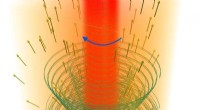
"This detection would be only the second time a polar field reversal has been observed on any star beyond the Sun, and the first time that it is caught before it happens," said lead author David Lattimer, a graduate student at the University of Arizona. "A polar field reversal would mean a complete restructuring of the star's magnetic field."
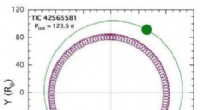
GJ 3512, located 30 light-years from Earth, is a relatively young and active red dwarf star that hosts two known exoplanets. It has been observed by TESS since the space telescope began science operations in 2018. The team used TESS observations spanning over two years to investigate changes in the brightness of GJ 3512 caused by starspots, which are dark regions on the star's surface that form due to magnetic activity.
"Magnetic fields and activity play an important role for any planets orbiting GJ 3512," said co-author Evgenya Shkolnik, an associate research professor in Steward Observatory at the University of Arizona. "So, if its magnetic field is indeed reversing, it will likely have an effect on the habitability of its planets."
The researchers found that the star's starspot coverage—the amount of its surface covered by starspots—has been decreasing over the past few years, suggesting that its magnetic activity is declining. This decline in activity is expected to continue until the magnetic field reversal occurs, which the researchers estimate could happen within the next decade or so.
"Detecting this potential polar field reversal on GJ 3512 is particularly exciting because it's the first magnetic reversal candidate TESS has given us," said co-author Joshua Schlieder, also an associate research professor in Steward Observatory. "It's also exciting to think that we might catch the actual flipping of the magnetic poles as it happens."
The observations of GJ 3512 provide insights into the magnetic activity of red dwarfs and its implications for the potentially habitable planets that orbit these stars. The study was published in the journal Nature Astronomy.