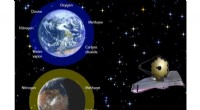
Exoplanet WASP-69b is a hot Jupiter, a type of gas giant planet that orbits very close to its star. It is located about 650 light-years from Earth in the constellation Sextans. WASP-69b is about the size of Jupiter, but it has only one-tenth of Jupiter's mass. This makes it a very puffy planet with a very low density.
WASP-69b orbits its star every 4.3 days, and it is tidally locked to its star, which means that one side of the planet always faces the star. The side of the planet that faces the star is extremely hot, while the side that faces away from the star is extremely cold. This temperature difference creates a strong wind that blows from the hot side of the planet to the cold side.
The wind on WASP-69b is so strong that it carries away particles of gas and dust from the planet's atmosphere. These particles form a tail behind the planet, much like the tail of a comet. The tail of WASP-69b is about 10 million kilometers long, and it is visible in infrared light.
The tail of WASP-69b is helping scientists to learn more about how planets evolve. By studying the composition of the tail, scientists can learn about the composition of the planet's atmosphere. They can also learn about the planet's rotation rate and its magnetic field.
The tail of WASP-69b is a fascinating phenomenon that is helping scientists to learn more about the evolution of planets. It is a reminder that even though WASP-69b is a very different planet from Earth, it is still subject to the same physical laws that govern our own planet.
Additional Information
* WASP-69b was discovered in 2012 by the Wide Angle Search for Planets (WASP) project.
* WASP-69b is the first hot Jupiter to be found with a comet-like tail.
* The tail of WASP-69b is thought to be composed of hydrogen, helium, and carbon monoxide.
* The tail of WASP-69b is about 1% of the planet's mass.
* WASP-69b is a member of a multiple star system. It orbits a binary star system consisting of two stars that are about the same size as our Sun.