Gravitational Infall: Matter from the surrounding environment, such as a companion star or an accretion disk, falls toward the black hole due to its immense gravitational pull.
Angular Momentum: As the infalling matter approaches the black hole, it carries a significant amount of angular momentum, which causes it to form a swirling disk around the black hole.
Magnetic Field Generation: Within the accretion disk, various processes, such as shear and differential rotation, generate strong magnetic fields. These magnetic fields thread through the disk and become amplified by dynamo processes.
Magnetic Arrest: The magnetic fields exert a Lorentz force on the charged particles in the disk, effectively arresting their inward motion. This magnetic pressure balances the gravitational pull of the black hole, preventing the matter from falling directly into the black hole.
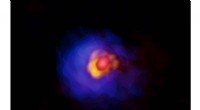
Formation of MAD: The combination of the infalling matter, the rotating disk, and the magnetic fields leads to the formation of a MAD, where the accretion of matter onto the black hole is significantly slowed down and regulated by the magnetic forces.
Inflow-Outflow Cycle: Within the MAD, there is a continuous cycle of matter inflow and outflow. The magnetic fields transport the accreting matter toward the black hole, but a fraction of the matter is also expelled in powerful jets and winds due to magnetic reconnection events.
Radiation: The intense magnetic activity and interactions within the MAD produce high-energy radiation, including X-rays, gamma rays, and radio waves. The emission of this radiation is influenced by the magnetic field structure and dynamics.
Truncation of the Disk: The presence of strong magnetic fields and the outflow of matter can lead to the truncation of the accretion disk at some distance from the black hole. This forms a compact, inner region where most of the accretion and energy release occur.
It's important to note that MAD accretion represents one of several models proposed to explain the behavior of matter around black holes. Different accretion models may apply to different astrophysical systems and conditions.