For the first time, astronomers have observed what appears to be a pair of black holes forming inside a dying massive star. The discovery, made using the European Space Agency’s Very Large Telescope (VLT), provides new insights into the final moments of a star’s life and the formation of black holes.
The dying star, known as LB-1, is located in the Small Magellanic Cloud, a small satellite galaxy of the Milky Way. It is a type of star known as a Wolf-Rayet star, which are massive stars that have lost most of their outer layers of gas. As a result, they are very hot and luminous, and they emit strong winds of gas.
In the case of LB-1, the winds of gas are so powerful that they have created a dense cocoon of gas around the star. This cocoon is so dense that it is blocking out light from the star, making it difficult to observe directly.
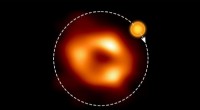
However, the VLT was able to peer through the cocoon using its powerful infrared capabilities. The observations revealed two bright spots near the center of the cocoon. These bright spots are thought to be the two black holes that are forming.
The black holes are thought to have formed as follows: The massive star collapsed under its own gravity, creating a supernova explosion. The explosion blew away most of the star’s outer layers, leaving behind a dense core. This core then collapsed further, forming two black holes.
The discovery of this black hole pair is important because it provides new information about the final moments of a star’s life and the formation of black holes. It also suggests that black hole pairs may be more common than previously thought.