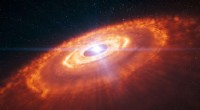
1. Black Hole: If the total mass of the merged system exceeds a certain threshold (about 2.5-3 times the mass of the Sun), the gravitational pull becomes so strong that the object collapses into a black hole. The black hole will have a mass greater than the sum of the masses of the original neutron stars, as some mass is converted into energy during the merger.
2. Neutron Star: If the total mass of the merged system is below the black hole threshold but still above a critical value (about 1.4 times the mass of the Sun), the result can be a single, rapidly spinning neutron star. This new neutron star may be supported by centrifugal forces instead of neutron degeneracy pressure, leading to a highly distorted and rapidly rotating object known as a "supramassive" or "millisecond" neutron star.
3. Hypermassive Neutron Star: In some cases, the merger can produce a short-lived, extremely massive neutron star that exceeds the maximum stable mass for neutron stars. Such a hypermassive neutron star is unstable and will ultimately collapse into a black hole.
4. Magnetar: Neutron star mergers can also result in the formation of a magnetar. A magnetar is a neutron star with an extremely strong magnetic field, up to a quadrillion times stronger than the Earth's magnetic field. The intense magnetic field can power various electromagnetic phenomena, such as radio and gamma-ray bursts.
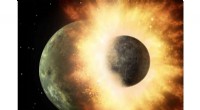
5. Kilonova: During and after the merger, there is often a significant amount of mass ejected in the form of debris. This debris can be heated to extremely high temperatures and emit bright, transient optical and infrared radiation known as a "kilonova." The kilonova provides important insights into the nucleosynthesis processes that occur during neutron star mergers, and it can also help astronomers study the formation of heavy elements in the universe.
6. Gamma-Ray Burst: Neutron star mergers can also be associated with short gamma-ray bursts (GRBs). GRBs are extremely powerful explosions that release enormous amounts of gamma-rays and other forms of high-energy radiation. Short GRBs are thought to be produced by the jets of material that are launched from the vicinity of the merger.
The specific outcome of a neutron star merger depends on theの詳細 parameters of the system, and astronomers use observations and theoretical models to study these events and understand their implications for the evolution of the universe and the formation of heavy elements.