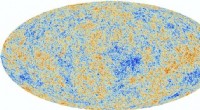
According to the theory of cosmic inflation, the universe underwent a brief period of exponential expansion during its early moments. During this period, quantum fluctuations in the matter field grew rapidly, creating primordial density perturbations. These perturbations then acted as seeds for the growth of structures in the universe, including galaxy clusters.
Specifically, the density perturbations created during cosmic inflation caused some regions of the universe to be slightly denser than others. These overdense regions then began to grow under the influence of gravity, eventually collapsing under their own self-gravity and forming galaxy clusters.
This process, known as gravitational collapse, is the primary mechanism by which galaxy clusters are formed. Gravitational collapse is accelerated by the dark matter component of the universe, which provides additional gravitational pull without contributing to the visible light emitted by galaxies.
Therefore, quantum fluctuations in the early universe, amplified through cosmic inflation, can contribute to the creation of massive galaxy clusters by seeding the initial density perturbations that eventually lead to gravitational collapse and galaxy cluster formation.