- A massive star (8-15 solar masses or more) exhausts its nuclear fuel.
- The star's inner core becomes iron, which cannot produce energy through fusion.
- Gravitational collapse ensues due to the lack of outward pressure from fusion.
2. Formation of a Neutron Star or Black Hole:
- As the core collapses, electrons and protons combine to form neutrons, releasing neutrinos.
- If the star's core is less than about 3 solar masses, it transforms into a neutron star due to neutron degeneracy pressure.
- For cores more massive than this, gravity overwhelms neutron degeneracy pressure, leading to the formation of a black hole.
3. The Supernova Explosion:
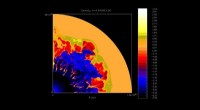
- The collapse triggers a release of gravitational energy, bouncing the outer layers of the star outward in a powerful shock wave.
- This shock wave heats the stellar material, causing a sudden and dramatic brightening of the star—the supernova.
- Temperatures and densities reach such extremes that various elements are synthesized through nucleosynthesis.
4. Supernova Remnant:
- The expanding debris from the explosion creates a supernova remnant (SNR).
- This glowing cloud of gas and dust remains visible for thousands to millions of years.
- Supernova remnants contribute to the recycling of matter in the universe, enriching the interstellar medium with heavy elements.
5. Impact on Earth:
- Supernovas that occur within a few hundred light-years of Earth can have profound effects on our planet.
- Intense radiation and high-energy particles emitted during the explosion can affect Earth's climate, ozone layer, and even cause mass extinctions.
- Supernovas also serve as powerful sources of cosmic rays, which play a role in cloud formation and atmospheric processes.