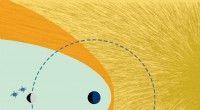
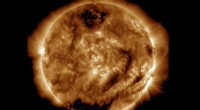
An aurora is a natural light display in the sky, particularly in the high latitude regions (around the Arctic and Antarctic). Auroras are produced when the magnetosphere is sufficiently disturbed by the solar wind. These disturbances are caused by variations in the solar wind that produce major changes in the currents and fields in the magnetosphere. Solar wind consists of charged particles that escape from the Sun's atmosphere. These charged particles flow out into the solar system and interact with the magnetic fields and atmospheres of the planets that they encounter.
How do auroras work?
The process starts when charged particles from the Sun collide with atoms and molecules in Earth's atmosphere. This collision causes the electrons to move to a higher energy level. When they return to their original energy level, the electrons release their energy in the form of light.
The color of the aurora depends on the type of atom or molecule that is collided with. Nitrogen atoms produce a greenish-yellow light, while oxygen atoms produce a reddish-orange light.
Auroras are most common during periods of high solar activity, such as solar flares and coronal mass ejections. These events send large amounts of charged particles into the solar wind, which can interact with Earth's magnetic field and produce auroras.
Where can I see an aurora?
Auroras are visible in both the northern and southern hemispheres, but they are most common near the poles. The best time to see an aurora is during the winter months, when the nights are longer and the skies are darker.
If you want to see an aurora, you can travel to a high-latitude location, such as Alaska, Canada, or Scandinavia. You can also check online for aurora forecasts, which can help you predict when and where auroras will be visible.
Auroras and space weather
Auroras are not just a beautiful sight to behold, they are also an important part of space weather. Auroras can affect radio communications, power lines, and satellites. For example, a strong aurora can cause a radio blackout, which can disrupt communications between aircraft and air traffic control.
Auroras can also affect power lines, by inducing currents in the lines that can cause them to overheat and fail. In addition, auroras can damage satellites, by causing them to lose power or by disrupting their communications systems.
Conclusion
Auroras are a beautiful and fascinating natural phenomenon that can be seen in the sky above the Arctic and Antarctic regions. Auroras are caused by collisions between charged particles from the Sun and atoms and molecules in Earth's atmosphere. The color of the aurora depends on the type of atom or molecule that is collided with. Auroras are most common during periods of high solar activity, such as solar flares and coronal mass ejections. Auroras are also an important part of space weather, and can affect radio communications, power lines, and satellites.