The first step in this process is for the molecular cloud to become dense enough to collapse under its own gravity. This happens when the cloud reaches a critical density, which is about 10^(-21) grams per cubic centimeter. Once the cloud reaches this critical density, it begins to collapse inward.
As the cloud collapses, it fragments into smaller and smaller clumps. This is because the cloud is not uniform in density, and the denser parts of the cloud collapse more quickly than the less dense parts. The clumps that form in this way are called protostars.
Protostars continue to collapse and grow until they reach a point where they can no longer accrete any more matter. This happens when the pressure at the center of the protostar becomes so great that it halts the infall of gas and dust. At this point, the protostar is said to be in hydrostatic equilibrium.
When a protostar reaches hydrostatic equilibrium, it is considered to be a star. If the protostar is still small enough, it will not become the core of a larger planet but will end up as a rogue planet. However, if the protostar is large enough, it will continue to accrete matter until it eventually forms a giant planet with multiple moons.
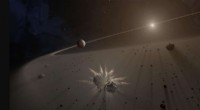
As the star system evolves, additional matter that does not become part of the planets accretes into planetary rings while smaller objects such as asteroids, meteors, and comets populate both the asteroid and Kuiper belts which reside between planet systems.